Introduction
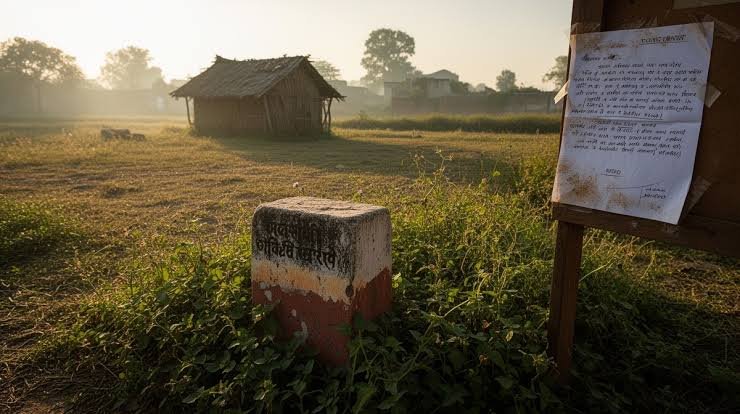
Encroachment, the unauthorised occupation of land, is a major problem in both urban and rural Rajasthan. It affects private plots, agricultural land, roads, and public utilities.³ Victims often face a long legal process, because removing an encroacher by force is not a lawful option. Self-help can invite criminal liability for trespass, which was punishable under Section 447 of the IPC and is now covered by Section 329 of the Bharatiya Nyaya Sanhita, 2023.
The Rajasthan High Court has dealt with this issue by balancing two interests: the owner’s right to property under Article 300A of the Constitution, and the need to remove illegal occupation. In practice, the Court has often paused demolitions for people with a credible claim, while insisting that authorities give notice and a fair hearing.¹
What Is Encroachment?
Encroachment is the occupation, construction, or use of land belonging to someone else without legal right. Common examples:
- Extending a boundary wall or construction beyond your own plot
- Occupying vacant private or agricultural land
- Building on government land, roads, or public pathways
- Blocking drains, common areas, or utility corridors
Why You Should Not Remove an Encroachment Yourself
Even a rightful owner who demolishes a structure or throws out belongings can face complaints for trespass, mischief, or assault. The safe route is always through the authorities or the courts.
Legal Remedies Available to the Owner
1. Legal notice and complaint to the authority. A written notice creates a record. For government or public land, complaints can be made to the Tehsildar or revenue authorities, the municipal body, or the development authority such as JDA.
2. Civil suit for possession and injunction. You can sue for recovery of possession under the Specific Relief Act, 1963, with a temporary injunction to stop further construction. If you were dispossessed without consent, a summary suit for possession can be filed within six months. A suit based on title generally has a 12-year limitation period, so delay can be costly.
3. Criminal complaint. Where the entry was unlawful and intended to intimidate, annoy, or commit an offence, a complaint for criminal trespass can be pursued under Section 329 of the BNS.
4. Writ petition before the High Court. If a public authority fails to act on clear encroachment of public land, or acts arbitrarily, a writ petition under Article 226 before the Rajasthan High Court, Jodhpur, may be appropriate.
How the Rajasthan High Court Approaches Encroachment Cases
The Court does not treat removal as a purely mechanical exercise. Recent orders show a consistent pattern.
Protection for genuine claimants, with a hearing. In Sitaram Sharma v. State of Rajasthan (June 2024), the vacation bench restrained JDA from demolishing constructions on private land where the petitioners claimed rightful title, pending consideration by the regular bench. The Court noted that it was not examining the petitioners’ title at that stage, only that they claimed possession of private land rather than public land. This was an interim order for those petitioners, not a general bar on JDA drives.
Protection for those with valid documents. In a May 2024 matter from Jalore, the Court directed that petitioners not be dispossessed from land held under pattas or sanads until the next hearing, and asked authorities not to dispossess people holding valid documents of possession.
No relief without proof of title. In Hari Ram v. State of Rajasthan (2025), the Court dismissed a challenge to a demolition drive in the Ummed Sagar Dam catchment area, noting that the petitioners had placed no document showing title over government land. Electricity bills or identity documents were not enough to establish a legal claim.
Public bodies must follow the Court’s directions. In Thana Ram v. Jodhpur Development Authority (2024), the Court issued show-cause notices to JDA and the District Collector for not complying with its orders to remove encroachments.
The takeaway: courts will remove encroachments from public land, but they expect due process, and your outcome depends heavily on the strength of your title documents.
Practical Steps If Your Land Is Encroached
- Collect documents: sale deed, jamabandi, mutation records, site plan, tax receipts.
- Get official demarcation of the boundary through the revenue department.
- Take dated photographs and videos of the encroachment.
- Send a legal notice to the encroacher.
- Choose the right forum: authority, civil court, or High Court, depending on whether the land is private or public.
- Act quickly. Delay can raise limitation and adverse possession issues.
Common Mistakes to Avoid
- Using force or hiring people to remove the encroacher
- Ignoring the problem for years
- Filing a case without official demarcation
- Relying on informal settlements without written records
Conclusion
Encroachment is frustrating, but the law offers clear remedies. Document your ownership, use the right forum, and avoid self-help. Rajasthan courts protect both the owner’s right to property and the occupant’s right to a fair hearing, so a well-prepared case with strong title documents is your best position.
Need help with an encroachment matter? Contact Harsh Gupta Law Offices to discuss your situation.
Disclaimer: This article is for general information only and is not legal advice. Reading it does not create an advocate-client relationship.